Are you thinking, “What does a license and certification mean?” as you look at a job application? Then, this complete guide will be very helpful! Because many professionals and students get these important terms mixed up. Thus, it can lead to costly mistakes.
Meanwhile, choosing between licensure and certification isn’t just a matter of words. It is the difference between having the legal right to work and having a badge of expertise that you can show off on your own time. This can cause people to waste time, miss the best opportunities, and even run into legal problems.
So, it is important to know the difference between certification and licensure if you want to move up in your job. Whether you work in healthcare, education, or technology, you should know it clearly. Don’t worry, though! By the end of this guide, you’ll know everything and also find a smart way to get both easily.
Certification vs Licensure: The Key Differences That Shape Your Career
To advance your job, you need to know the difference. Thus, you need a license to legally work and a certification to show that you’ve learned a lot. Let’s talk about what this means for you!
Free Price Calculator
Get to know about Daniel:
- For smooth communication I use WhatsApp; Contact me on WhatsApp
- Each Client has a separate WhatsApp group
- Watch videos of me taking real exams: Quora Space
- How my most popular WhatsApp method works: Daniel WhatsApp Method
- I am Ranked #1 tutor on YouTube, Check out my YouTube Channel
- I keep my Clients info highly confidential by encrypting your name to a 4-digit code
- Get discounts on your next orders by suggesting me to your friends
What is Licensure? The Legal Gatekeeper
To put the licensure definition simply, it is a required document issued by a government body, usually a state board. Plus, it is a legal document that says, “You have met the minimum standards set by the state to safely practice this profession.”
Moreover, you can’t work in that field without it by law. Licensure is a credentialing method established by law. So, to know the difference between certification and licensure clearly, here are some examples of professional licenses:
- In Healthcare: A Registered Nurse (RN) license from the state and a doctor’s medical license.
- In Education: A license to teach from the state.
- General: A license from the state for engineers (PE), psychologists, or cosmetologists.
Scope: A license is required and cannot be changed. As an example, what is the licensure meaning in healthcare? You are allowed by law to treat patients in that state. A lot of the time, you have to renew it and meet continuing education standards to keep it.
What is Certification? The Voluntary Badge of Excellence
On the other hand, certification is usually a non-government professional association’s award that people choose to get on their own. Plus, it shows that you have gone above and beyond the basic requirements and have specialized knowledge or skills.
Thus, you can think of it as an edge over your competitors. So, here are some examples of professional certifications:
- After getting your RN license, you can become a Certified Critical Care Nurse (CCCN).
- In tech, a CISSP certification stands for Certified Information Systems Security Professional.
- For project management, you need to get a Project Management Professional (PMP) license.
Scope: Certification shows that you have specialized knowledge and is often accepted across the country or around the world. Thus, excellence is important, not just following the law.
Side-by-Side: Know the Difference Between Certification and Licensure
| Feature | Licensure | Certification |
| 1. Who Gives It | A state government board or agency. This is a legal permission from the state. | A private professional organization or association. This is a professional endorsement. |
| 2. Is It Required? | Yes. It is mandatory by law. You cannot legally practice the profession without it. | No. It is almost always voluntary. It is an optional credential for career advancement. |
| 3. Main Goal | To protect the public. It ensures practitioners meet the minimum legal standard for safe practice. | To recognize expertise. It shows you have advanced, specialized skills beyond the basic requirements. |
| 4. How You Get It | You must meet state-set legal requirements: specific education, supervised hours, and pass a state-approved exam. | You meet standards set by a professional group, which always includes passing their exam, but may have flexible experience rules. |
| 5. What It Controls | Your legal right to do the entire job. It defines your full, legal scope of practice in that state. | Your recognition in a specialty area. It shows skill in a specific part of a larger profession. |
| 6. Where It Works | Usually, only in the state that issued it. You often need a new license to move to another state. | Often works nationwide or globally. The credential is usually recognized everywhere the organization operates. |
| 7. How You Keep It | You must renew it with the state, always requiring continuing education (CE) and a fee, to keep your legal right to work. | You maintain it with the certifying body, usually requiring continuing education (CEUs) and possibly a fee, to keep your credential active. |
| 8. Who Enforces Rules | The state licensing board. It can fine you, suspend your license, or stop you from working if you break state laws. | The certifying organization. It can take away your credential if you break its rules, but it cannot stop you from working if you still have a valid license. |
| 9. What You Can Call Yourself | It gives you a legally protected title (e.g., Licensed Architect, Registered Nurse). Only license holders can use these titles. | It gives you credentials to add after your name (e.g., John Doe, PMP, CCNA). It is a professional designation, not a legal title. |
| 10. What Happens If It Expires | You must stop working immediately. Practicing with an expired or revoked license is illegal. | You lose the right to use the credential, but you can often still do your job if your underlying state license (if required) is still valid. |
Certification and Licensure Across Professions: A Field-by-Field Guide
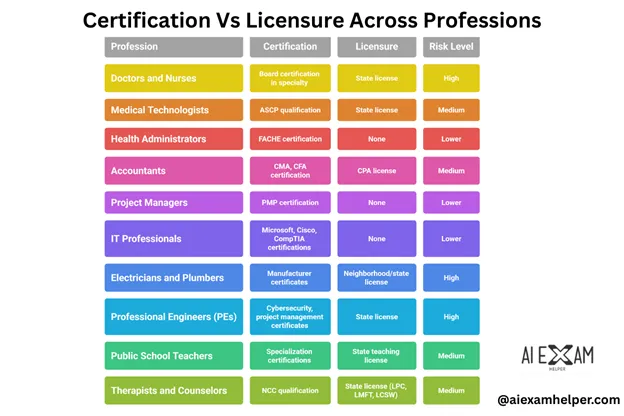
Let us look at some examples of how certification and licensure are used in different jobs. Plus, based on the risks and responsibilities of the job, their requirements change. Thus, the following highlights will explain the difference between certification and licensure in an easier way.
Healthcare Professions
- Doctors and Nurses (High Risk): They need a license from the state to work. This can’t be changed. If a doctor is licensed to do surgery, they can get a board certification in pediatric surgery to show that they are even more skilled.
- Medical Technologists (Medium Risk): To do lab tests, they usually need a license from the state or a certification that is required by law. As an example, a lot of states need MLTs to be qualified by ASCP.
- Health Administrators (Lower Risk): Most of the time, they don’t need a license from the government. Instead, they could get a certification like the FACHE on their own time to move up in their jobs.
Technology and Business Fields
- Accountants: You need a state license (CPA) to look over financial documents or defend clients in front of the IRS. For most jobs, you don’t have to have other qualifications, but the CMA or CFA is useful.
- Project Managers: You don’t need a license from the government. Plus, the PMP certification is the industry gold standard for showing competency.
- IT Professionals: Usually work without licensing. Some technical skills are proven by certifications from companies like Microsoft (Azure), Cisco (CCNA), or CompTIA (Security+).
Skilled Trades and Engineering
- Electricians and Plumbers: Always require a neighborhood or state license to ensure public safety. They may also have certificates from the equipment’s maker.
- Professional Engineers (PEs): The PEs need a license from the state to sign off on building plans or provide public engineering services. On top of that, they can get certificates in things like cybersecurity or project management. Thus, if you are an engineer, then this difference between certification and licensure will help you to shape your career.
Education and Counseling
- Public School Teachers: They must have a teaching license from the state. With certifications, you can specialize in things like reading or special education.
- Therapists and Counselors: They require a state license (LPC, LMFT, LCSW) to work independently. National qualifications, such as the NCC, can help you get a license or show that you are an expert in your field.
How Do These Changes Affect Your Exam Strategy?
Your study plan needs to match the credentials for your job. Daniel at AI Exam Helper suggests unique plans for each path:
- For license exams, you need to study state laws, safety rules, and the basic skills that are required by law.
- For certification exams, you have to emphasize best practices, advanced methods, and industry standards. Thus, this difference between certification and licensure can help anyone to prepare accordingly.
How Certification and Licensure Differ Across States?
Let’s talk about states now. Rules change a lot depending on where you work, especially when it comes to getting a license. Plus, licenses are area-based. A license that works in one state might not always work in another.
- Some states have deals with each other. As long as they have a multistate license from an NLC state, a nurse can work in other NLC states without getting a new license.
- Meanwhile, it is hard to get licensed in most occupations. If a licensed clinical social worker (LCSW) from Illinois moves to California, they need to get a new license for California. Thus, this may mean different regulated hours or more tests.
Even when there is agreement, each state has its own rules:
- Engineering in Florida vs. New York: Both need a PE license, but the tests may have different questions about state rules and ethics.
- Cosmetology Hours: In New York, you need 1,000 hours of schooling to get a cosmetology license, but in California, you need 1,500 hours. You might need more training if you move.
The Real Challenges: Why Students Struggle to Get Certification and Licensure?
Let’s be honest! Getting these credentials is not easy. Plus, stress about tests, complex application processes, expensive study materials, and too much knowledge can all be too much to handle. Thus, after knowing the difference between certification and licensure, here are the real challenges listed below:
1. You have one shot at the test.
Everything you have done leads up to one very important test or exam day.
2. The application process is confusing.
Rules for eligibility, forms, and board standards make it hard to find your way.
3. There is too much to study.
It is hard to decide what to focus on because there is so much to read apart from the daily busy schedule.
4. It’s expensive and time-consuming.
It takes a lot of time and money to pay for classes, fees, and supplies. Thus, just knowing the difference between certification and licensure is not enough.
5. Your study methods don’t work.
Reading passively won’t help you get ready for the structure and stress of the real test.
Why Do Candidates Fail? The Hidden Reasons
Common reasons for failure include:
- Ignoring the exam complexity. Most people take a test for a license, like a final in college.
- They don’t know what to focus on because of too much information.
- Most students and professionals practice poor time management. Plus, cramming leads to burnout.
- They depend on old or incomplete study materials.
Daniel’s Strategic Solution: Your Key to Stress-Free Success
Daniel at AI Exam Helper proves herself a game-changer. He knows that the main difference between certification and licensure in professional fields is very important, but passing the test is always the first step.
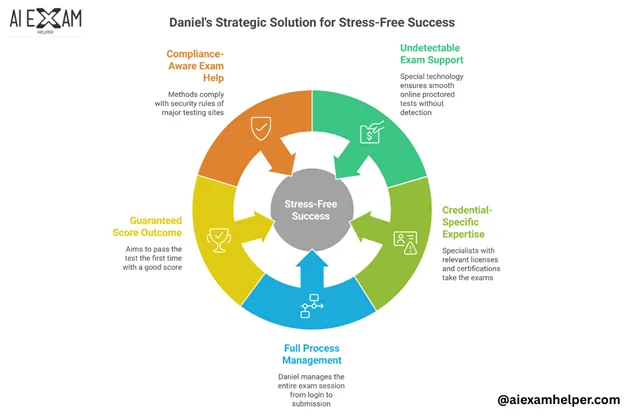
Thus, he has come up with a unique, advanced way to make sure you not only pass but also do very well. Plus, his service is not about taking typical shortcuts. It is about giving people a smart and effective success plan. So, Daniel gives:
Undetectable Exam Support
To help you with your online proctored test, he uses special technology that leaves no trace. This means that there won’t be any suspicious browser behavior, proctoring alerts, or recorded flags. Thus, there will only be smooth support.
Credential-Specific Expertise
The person who takes your exam is either a specialist who holds the license or certification you’re trying to get. Meanwhile, Daniel has already passed the board’s exams for different certifications and licensures many times. Plus, he knows the difference between certification and licensure requirements.
Full Process Management
Daniel is in charge of everything that goes on in the exam. He is in charge of the whole session, from the safe login to the end submission. Plus, it saves you time and keeps you from looking strange because you don’t have to switch tabs nervously.
Guaranteed Score Outcome
The goal is to pass the test the first time and get a good score. This saves not only your credentials but also your money by avoiding expensive retake fees. Plus, you can save your job offers that are held up due to a lack of certification or licensure.
Compliance-Aware Exam Help
His methods are made to work with the security rules of the main testing sites used for state license and national certification tests. Thus, it makes sure that everything goes smoothly and successfully without any risks to the process.
Let’s Take Your Next Step Towards Credential Mastery
To sum up, the major difference between certification and licensure in healthcare and all other fields is whether it is required by law or not. So, if you can’t pass the test, the pdf you download about the difference between certification and license won’t help. Thus, don’t let exams scare you away from your career goals anymore.
Thus, stop fighting with worry and confusion about what to do. Daniel at AI Exam Helper already knows how to use the system, which means you can safely plan for your future. Today, take a smart step and spend money on a service that wants you to succeed. Visit AI Exam Helper and let Daniel help you get your credential in a way that is sure to work.
FAQs
What does “license and certification” mean on a job application?
It asks if you have the state license you need to officially do the job, and any professional certifications you can get on your own to show you have advanced skills. If needed or important, you should list both.
What’s the difference between being “licensed” and “certified”?
Having a license means that the state has permitted you to legally work. If you are certified, it means that a professional group has confirmed that you are an expert in your field. Meanwhile, you can be both if you know the difference between certification and licensure clearly.
What is a “professional licensure examination”?
A professional licensure examination is the state-required test you must pass to get your legal license to practice your profession. For example, the NCLEX for nurses or the Bar exam for lawyers.