In this era where remote learning has become normal and online exams have changed the way of assessing knowledge, whether they are related to education, professional certifications, or some sort of online training session, understanding how do online exams work has become essential for every student or even for professionals.
That’s why this comprehensive guide delivered by Daniel will cover every essential piece of information from basic to complex online proctoring, and you’ll have more than enough knowledge at the end of the blog, and can easily start your online exam.
Let’s dive into every detail on online exams: “How Online Proctored Exams Work?” their benefits, disadvantages, proctoring system, step-by-step process, and technologies used in online exam software.
What are online exams?
Online exams are also referred to as e-exams or digital assessment tests, which are conducted by several universities or colleges either for education, certifications, or online training sessions via the internet. The main purpose is to actually determine the examinee’s skills, knowledge, or abilities about that specific subject.
Free Price Calculator
Get to know about Daniel:
- For smooth communication I use WhatsApp; Contact me on WhatsApp
- Each Client has a separate WhatsApp group
- Watch videos of me taking real exams: Quora Space
- How my most popular WhatsApp method works: Daniel WhatsApp Method
- I am Ranked #1 tutor on YouTube, Check out my YouTube Channel
- I keep my Clients info highly confidential by encrypting your name to a 4-digit code
- Get discounts on your next orders by suggesting me to your friends
Moreover, the pattern of the test may be simple MCQ-based, theoretical, or practical, depending on the institution or subject type. Some online exams have time limits in which the test taker has to complete the exam, and after that, all questions are blocked automatically by the system.
Unlike traditional paper exams, which need presence and proper space in centers, the online exam system allows students to take the exam from anywhere via the internet with advanced AI or live proctor supervision.
- Do you know how the online exam system was introduced in history?
Let me tell you a brief history of it. Firstly, through learning management systems (like Moodle or Blackboard), basic digital quizzes were introduced in the early 1990s. Then, gradually around the 2000s, e-learning started gaining more importance and was used by various platforms.
Then, eventually, the pandemic (COVID-19) accelerated online exam and learning systems, and most of the classes and exams were being conducted online. Today, artificial intelligence and online exam tests are being enhanced and are more reliable, ensuring that learning, certifications, or sessions are not being interrupted in any way.
Types of online exams and proctoring methods?
Ever wondered whether online exams are proctored or unproctored? So the simple answer is it can be both, depending on the institutional requirements and test severity. Most organizations use proctored online exam systems because unproctored exams are more prone to cheating, as they are done without supervision, while, on the other hand, proctored exams are precisely monitored using different technologies and software to maintain academic integrity.
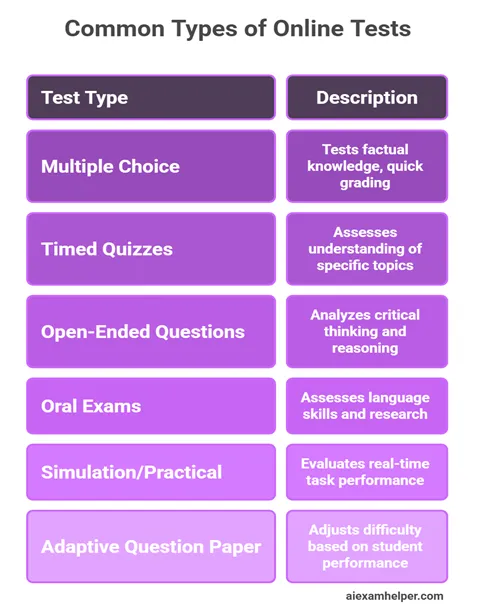
Common types of online tests
Different universities and organizations choose the format for online examinations based on the subject-specific requirements, assessment goals, or security needs. Some organizations test the students with their practical skills or knowledge, while others focus on the theoretical understanding of that specific subject.
No matter what the exam format is, always check the requirements before taking an online exam and prepare accordingly to ace any subject. Let me tell you what different formats are used to measure students’ skills.
- Multiple choice:
For testing factual knowledge and a quick grading system, objective-based exams are performed that are easily assessed or even automatically checked by an AI system.
- Timed quizzes or assessments:
Mostly for weekly assessments of students in which there is a need to check students’ understanding of a specific topic, time-restricted quizzes are performed online.
- Open-ended or essay-based questions:
Through an open-ended questionnaire, examiners analyze students’ critical thinking and the ability to provide reasoning and explanations of their unique ideas.
- Oral or viva exams:
Mostly for language tests, interviews, or final research evaluations, examiners prefer face-to-face or oral interaction with the students for better assessment, and video conferences are conducted.
- Simulation or practical-based paper:
In subjects where practical work is essential, for instance, in technical, IT, or engineering fields, real-time task performance is done by using advanced software and analyzing their coding or data analysis ability.
- Adaptive question paper:
In such proctoring online exams, the whole structure of the paper is not structured beforehand, but it adapts to the students’ handling capacity of difficult questions. The examinee’s performance determines the difficulty of next question they perform.
Online proctoring methods
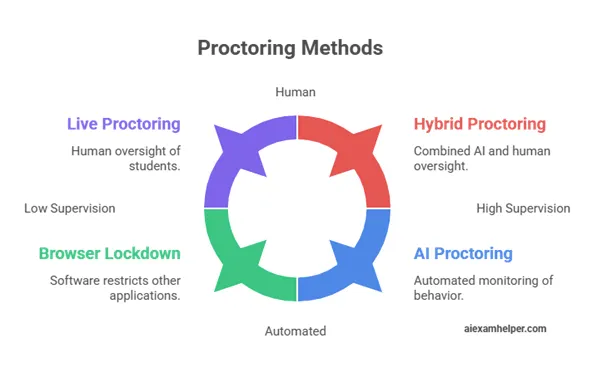
As the structure of online exams can be different for different subjects or universities, the way of proctoring students to maintain academic integrity can also differ, shaped by the authorities. Remote proctoring ensures exams are conducted fairly without any risk of cheating. Here are the online proctoring systems mostly used.
- Live online proctoring:
A live human proctor is analyzing all your behaviours and surroundings through the webcam and can trigger flags and demand surrounding footage whenever needed. One live proctor can typically handle 30 students at a time for more precision.
- AI proctoring:
No human proctor is involved, but the whole exam is being monitored by advanced AI software, which detects unusual facial and body movements, checks surroundings, and observes background noises precisely to avoid cheating.
- Recorded and reviewed:
The whole session or exam timeline is recorded and afterwards assessed by professionals, and in case of any detection of unusual behavior or presence of a second device, the test is flagged and voided.
- Hybrid proctoring:
For higher security or high-stakes exams, organizations may use both AI and human proctoring, where both work simultaneously. AI detects the issue, and the human proctor analyzes it and takes action. Sometimes, the sessions are recorded for further review and enhanced precision.
- Browser lockdown:
It is software used by proctors to restrict other applications or websites on the computer or laptop during the test so that students don’t use them as a source of information.
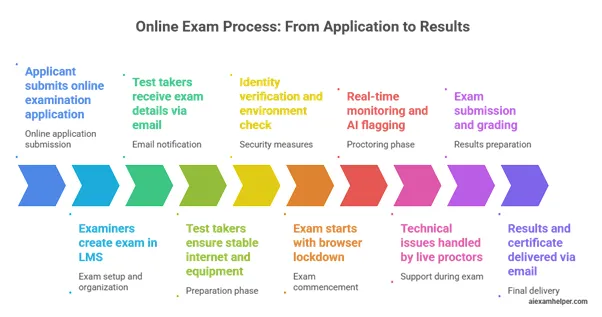
How Online Proctored Exams Work & Are Conducted? Applying the process to the final results.
Let’s break down the step-by-step process of how do online exams work and how you can start the process of taking exams online. First, the applicant submits an online examination application on the respective exam portal; after that, the further process starts.
Setup and preparation:
The online exam system starts with the examiners, who create an exam in learning management systems (LMS) by organizing the questions, setting the timeline, choosing the proctoring method, and then notifying the test takers through an email mentioning exam details, instructions, or access links.
However, the students in the meantime ensure that they have a stable internet connection, a working microphone and webcam, a compatible device (laptop, computer, or mobile phone), and a smooth-running browser.
Install the software/browser used in the online exam, set it up, and check it by running it before the actual exam as a test, and if there are any issues, fix them early.
Identity verification and environment check:
Maintaining security is essential in such online exams because the chances of dishonesty increase, and students are more likely to cheat. So a proper identity and background check is done before starting the exams. This process may take 5-15 minutes, which includes
- Inputting login credentials (email and password)
- Biometric or facial recognition by taking a live selfie
- Valid ID upload and verification
- Entire room scan through webcam surveillance, including desks, walls, and floor, to ensure there are no hidden notes or other functional devices
- Accessory checks are done in pockets, wrists, or ears to ensure no hidden smart devices are being used during the exam.
These multi-layered security checks guarantee that no impersonation is done and no unauthorized material is being used. It upholds academic integrity, delivers fair results, and maintains the integrity of AI online examination platforms.
During the exam:
After the security and background checks are done, the exam starts. As soon as it starts, the system locks down the browser, restricting any tab switches, screenshots, googling, copy-pasting, or usage of external apps.
At that moment, real-time monitoring starts, and you’ll begin your online proctor exam. The webcam continuously tracks your eye movements, body posture, screen activity, background noises, and network activity.
AI flags any unusual behavior (voice detection, second-person activity, irregular eye movements, screen sharing, or smart device detection) and notifies the live proctor, and he will take action accordingly after verification.
In case of any technical issues, support is provided by live proctors, so inform them quickly about the pause and explain what happened clearly. During the exam, make sure to manage the time properly if it is a time-restricted exam.
Post-exam review and submission:
When submission is done, the MCQ-based online exams are graded automatically by AI, while the subjective questions need proctor analysis. AI or a human proctor reviews the recordings, checks the question paper, and prepares a proper report in which grades and marks are clearly mentioned. These reports, usually with a certificate, are delivered to test takers via email.
Key technologies and features used in online exams
In online exams, several types of software or technologies are used to make sure that the system works smoothly and the exam takes place fairly without any risks of breaching, cheating, or tampering.
Moreover, in online proctored exams, reliability is the main concern for both the examiner and the examinee, and it should truly reflect the abilities and knowledge of the student. To achieve these accurate results, different technologies are used in online exams, including
- Proctoring tools (video, audio, and image proctoring),
- AI integration,
- Facial recognition and biometrics,
- Lockdown browser,
- Data encryption, or
- Proctoring software used, such as Examity, pearson VUE, honorlock, mcgraw hill connect, etc.
Pros and cons of online exams
In this digital world, as the use of AI has increased, the use of online platforms for education is also skyrocketing, and most of the universities, colleges, and training institutes use online examination systems to measure test takers’ skills without the need of large examination halls, costly printing, or invigilation worries, while online proctored exams at home handle everything and boost accessibility.
Online exam tests have both pros and cons, but definitely today’s artificial intelligence and advanced technologies are reducing the disadvantages to a minimum. Let’s discuss both the disadvantages and advantages of online examinations.
Pros:
For students:
- Flexible scheduling
- Builds digital skills
- Saves time, money and energy
- Home-based testing
- Faster results
- Instant feedback
- Reduce stress and enhance performance
For institutions:
- Massive scalability (no extra staff or huge revenue needed)
- Significant cost savings
- Enhance global reach
- Rich performance analytics
- Automated and accurate grading
Cons:
Along with advantages, online university exams also have to face some challenges from both the examiners and the examinees.
- Online exams completely rely on internet connection, so a slight disruption in the connection can lead to major downfalls in the exams. Technical issues that arise during exams are the main headache for most of the examiners.
- While taking the exams online, the risk of cheating also increases. Unproctored exams are more susceptible to cheating, but the proctored online exams (AI or human) somehow manage to reduce the risk by 70-80%, but they can’t completely stop it. Most of the students succeed in cheating using advanced software and techniques. That is the main concern for examiners.
- Sometimes, continuous monitoring stresses out the students, and their performance can be reduced due to anxiety. They also develop privacy concerns, which downscale their confidence.
- Moreover, when students don’t practice before the exam, then it is more likely that they fail to implement the software at the right time. This leads to delays and failure during the exam.
Pro tips for success in online exams
To ace any online exam, there are basic preparations that every student should consider to prevent interruptions, errors, or unintentional AI flags that can affect the credibility of your test.
- Choose a quiet and distraction-free spot for the test.
- Pre-run the exam system to ensure no technical errors are occurring.
- Prepare yourself by taking demo quizzes or practice sessions available on the website, provided by either the institution or a proctoring service (e.g., Examity, Proctorio, or Honorlock). Master the exam interface beforehand.
- Prepare all the required documents, such as ID, passport, or other related certificates that they might demand during the verification process.
- Read the test guidelines and rules carefully regarding behavior analysis, permitted or unpermitted devices, required documents, or time policy.
- Avoid multitasking, such as chatting, tab switching, browsing, phone usage, or messaging. It can raise suspicious and automated flags.
- Manage your time efficiently throughout the online examination.
- Remain composed and don’t panic if there is an unexpected flag or a technical glitch during the exam. Handle it calmly by raising your hand, explaining the issue to the live proctor, and following the instructions provided by the proctor so that you’ll not get any penalties or voidance.
Can you cheat in online exams? Get Daniel’s help.
When you are dealing with a lot of things at the same time—preparing the exam, setting the room, managing technical issues, and trying to run software without any hurdles—most students start thinking, “Is it possible to cheat in an online exam?”
Always stick to honesty, and when the burden overflows, don’t try to use cheating hacks like using a mobile phone, browsing on other tabs, etc., because online proctoring software can easily detect such old hacks of cheating, and the punishment could be worse, even leading to expulsion from school.
If you need help for your online exams, seek professional help from Daniel, your personal AI exam helper. He is available 24/7 for your support and handles every issue effectively and can even take the exam for you. He has extensive knowledge about how do online exams work and how to handle technical fluctuations and software failures efficiently.
Final words:
Remember, if you are going to take an exam online, then first understand what a proctored exam is and how online exams work, and then practice operating the software before the actual test starts. Online examinations are high-stakes tests that combine convenience, security, and scalability to revolutionize assessment. So prepare well, and if you need expert help, contact Daniel at any time and from anywhere.
FAQs:
Is online proctoring safe and secure for exams
Yes, definitely. With its advanced AI or live human-based online proctoring, testing, and encryption policies, all the data, login information, and overall recordings are kept safe and private.
Can a proctored exam see your screen or detect a phone?
Yes, proctored online exams have complete access to screen activity, and they monitor every action occurring on the screen or in the background. It can also detect phones, as it is a web-protected exam, so any unusual behavior, like continuous down movements or sound vibrations caught on the webcam feed, triggers suspicion.