It is definitely frustrating when your proctored exams use Respondus Lockdown Browser or Proctorio, and the unintentional activation of screen mirroring leads to alerts and triggers flags, and in the worst case, your test gets voided. So, asking yourself, “How to turn off screen mirroring in my device?” before taking any online exam is a smart move for every student to prevent accidental academic failures.
Furthermore, Daniel is an expert in handling tech-related issues such as screen mirroring or accidental execution of it. He knows exactly what factors trigger it the most and how to handle it. So if you don’t want to tackle unnecessary issues, explore Daniel’s guide and avoid academic failures, and if you want, Daniel can handle your proctored exams for you with efficiency and credibility.
Understanding screen mirroring: what it is and why it matters in proctored exams
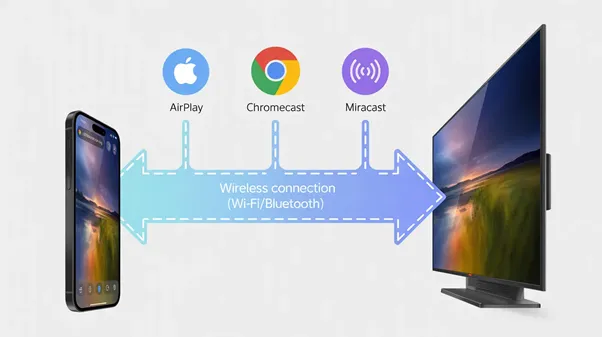
Screen mirroring is a technology where someone can mirror their screen activity on other devices, such as a TV, monitor, computer, or cell phone. This technology is considered great as long as it is used for beneficial purposes, such as giving presentations or streaming movies on bigger devices, but it can affect academic integrity during online exams.
There are different tools, like ProctorU, Exemplify, or Respondus LockDown Browser, that not only detect your webcam but also your device’s screen behavior and network activity. Even if you don’t turn it on intentionally, it can activate automatically due to various factors and cause disturbance during exams.
Free Price Calculator
Get to know about Daniel:
- For smooth communication I use WhatsApp; Contact me on WhatsApp
- Each Client has a separate WhatsApp group
- Watch videos of me taking real exams: Quora Space
- How my most popular WhatsApp method works: Daniel WhatsApp Method
- I am Ranked #1 tutor on YouTube, Check out my YouTube Channel
- I keep my Clients info highly confidential by encrypting your name to a 4-digit code
- Get discounts on your next orders by suggesting me to your friends
Common triggers that spark screen mirroring issues during online exams
Keep in mind that mirroring doesn’t always need deliberate action to proceed; it sometimes triggers itself by common issues. These issues should be considered seriously, especially when you are taking an important online exam and don’t want to spoil it because of an unintentional error.
- When you have shared wifi networks, especially in a hostel or dorm, it can activate screen mirroring on other devices like TVs or monitors.
- When you accidentally leave the device discoverable option on, it can accidentally start mirroring your device without any user action.
- When you allow the screen sharing permission on other apps, such as Zoom or video calls in the background, this can also trigger screen mirroring.
Remember, even a small notification of screen mirroring on your device during a proctored exam can trigger flags and affect your exam results. So it is a clever move to know about how to stop screen mirroring and how you can reduce the chances of accidental mirroring during exams. That is what Daniel, your personal AI exam helper, does for you and provides every detail regarding screen mirroring and even handles these issues for you so that you don’t worry about them.
How to stop screen mirroring on every platform: Complete Guide
Now that you know what screen mirroring is and what actions trigger it accidentally, it is time to discover how you can turn it off on different devices. Whether you want to know about how to turn off screen mirroring on iPhone camera, stop screen mirroring to TV or how to turn off screen mirroring on Android, Mac, or a laptop, this Daniel’s perfect guide covers everything.
Note: Before diving into device-specific instructions to stop mirroring, make sure to restart your device to clear background connections and switch to a private network, either Wi-Fi or personal data, to prevent unintentional activity. Also, close the apps like Zoom or video call apps that can trigger mirroring in any way.
These preparatory steps will prevent you from accidental mirroring during proctored exams and will help you to maintain integrity.
iPhone/iPad
If you are one of the iPhone users struggling with mirroring issues and need a clear guide for how to stop screen mirroring on iPhone during online exams or how to stop screen mirroring iPhone to TV after online streaming, then you are definitely at the right spot. Daniel provides you with clear guidelines to stop mirroring.
● How can you turn it off?
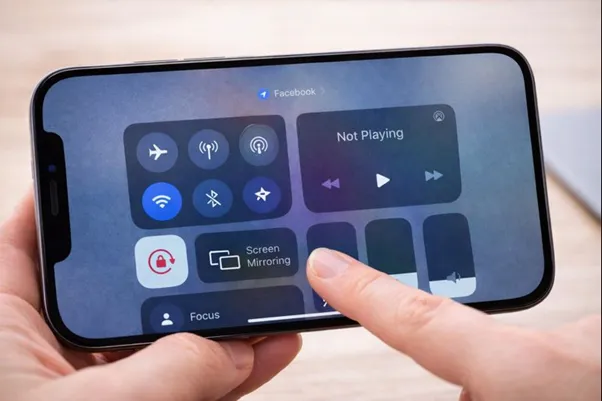
Firstly, open the “control center” by dragging the “settings” list from the top right corner, where you can easily find the “screen mirroring” or “AirPlay” icon. For clarity, the icon looks like a rectangle shaped from the outside and a triangle in the middle of it. Open it and select “stop mirroring.”
Furthermore, if it still causes disturbance, then go to the “general” settings, open “AirPlay and Handoff,” and turn off any options related to screen mirroring, like “automatically mirror on TV.”
Android
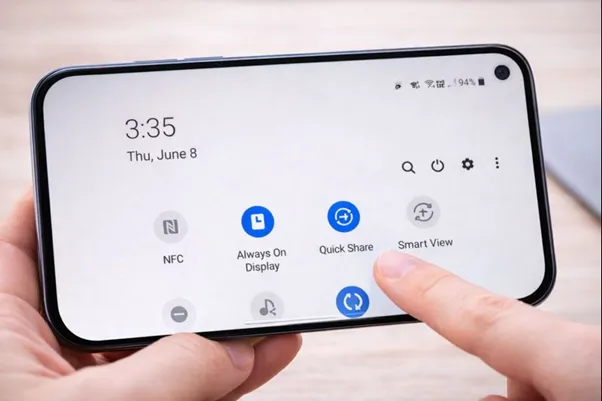
For Android users to know how to turn off screen mirroring Samsung or Samsung TV, it might be confusing, as different devices may have different options to stop mirroring. For instance, Samsung Galaxy phones have a smart view icon in quick settings, Google Pixel uses Cast, and Huawei may use multi-screen, while the mirroring option in others might be Screen Cast or Mirror Cast.
● How can you turn it off?
To stop screen mirroring on Android, double-swipe from the top to open quick settings and tap and hold onto the “Smart View” option. It will allow you to see the “stop mirroring” option with the connected devices. Disconnect it and take your exam without further issues.
Note: Make sure there are no Google apps running in the background because they can trigger Chromecast, and it can create disturbances during exams. You can get help from Daniel, who is an expert in managing such issues with precision, so if you don’t want accidental issues, let Daniel handle them for you.
Mac
Wondering how to turn off screen mirroring on MacBook? macOS has a smooth mirroring process.
● How can you turn it off?
Just open the “menu” bar and locate the “AirPlay” icon, and if it is connected, turn it off and disable mirroring from your device.
Alternatively, you can use the following steps. Menu” (with Apple icon on top left) > System Settings > Display > AirPlay Display. Then, turn off the AirPlay display.
- Most students wonder why they keep getting mirroring suggestions on their iPhone or Mac, even when they turn off the screen mirroring or auto display.
This is because your AirPlay suggestions or show mirroring options might be enabled, so turn them off if you don’t want suggestions to appear on your screen.
- For this purpose, open settings on your iPhone, then go to the “General” and “AirPlay and Handoff” options. From there, turn off mirroring options. For Mac, go to “Displays” from “Settings” and “Disable AirPlay” or the related options so that you don’t get any suggestions during exams.
Laptop or Windows
How to stop screen mirroring on laptops or Windows is a common question among students giving proctored exams on either the lockdown browser or Exemplify. No worries, and here is your quick answer.
● How can you turn it off?
To stop screen mirroring on Windows, the quick action you can take is to press the Windows icon + K to discover connected devices. Then disconnect all the devices to prevent mirroring.
To stop mirroring permanently, you can follow the simple steps and ensure that your device will not connect to any other device while you are taking the online exam. Go to the “settings” from the window icon in the taskbar at the bottom. Then, continue by clicking “display” and “multiple displays.” From there, remove permissions to connect wireless displays.
Smart TVs
You must feel frustrated when your device automatically connects to the TV. This is a common problem, so you should know how to stop screen mirroring on TV from Android, iPhone, or any other device.
● How can you turn it off?
On Samsung TVs, you need to open the menu, select “network,” choose “expert settings,” and then locate “device connectivity” to turn it off.
In Roku, the screen mirroring option is available in the “system” from “settings”; set the screen mirroring option to “never allow” and get rid of accidental screen mirroring.
For Google Chromecast devices, use the app itself and “forget all the devices,” and if you don’t know how, simply “reset it” to avoid mirroring.
With all these steps, you can easily prevent the unexpected screen mirroring during exams. But Daniel, as the experienced exam helper, always advises students to always check the connectivity before proceeding to any proctored exam to ensure that it doesn’t connect to any nearby device. Daniel provides full-time guidance and even handles your proctored exams efficiently without any risks of screen mirroring.
Advanced ways to prevent screen mirroring during exams forever
To restrict unauthorized sharing, sometimes you need to go beyond the basic instructions, especially when you are giving proctored exams on Respondus Lockdown Browser, Proctorio, Exemplify, Pearson, or Honorlock, which detect even small disturbances in screen and network activities.
Follow these steps before taking any exam monitored by the above browsers and restrict red flags triggered by small connections. Now, without further delay, let’s walk you through the secure exam preparation steps.
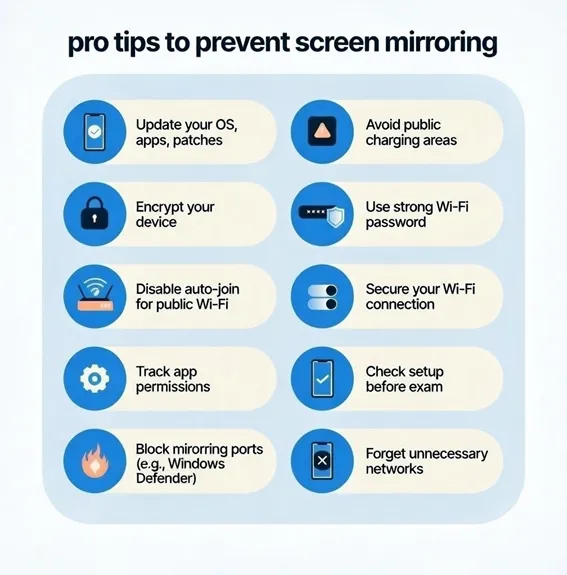
- Turn off casting options and disable Bluetooth and Wi-Fi from your device if it is crowded, and use a private network instead.
- Track app permissions thoroughly and forget all the connected devices.
- Also, disable the auto-join option for public wifi networks and forget all unnecessary networks for smooth running.
- Secure your wifi network you are going to use during the online exam with a strong password so that it isn’t easily connected by neighbours and your screen isn’t accidentally mirrored.
- Don’t skip upgrading your OS, apps, or security patches.
- AirPlay, Chromecast, and other mirroring apps use internet ports, which you can block using built-in Windows Defender firewalls.
- Avoid public sharing charges.
Always check your setup before taking the exam by trying to connect it with other devices. If it doesn’t connect, then you are all good, but even then, it creates interruptions; let Daniel handle all your problems. He is a specialist in handling basic mirroring issues and can bypass your proctored exams efficiently.
Let Daniel take care of all your exam tech stress
Is Proctor software acting suspicious? Screen mirroring notifications keep popping up during the exam? Tired of fixing issues? Most students face these problems regarding screen mirroring, and you are definitely one of them; that is why you are here.
One of the most common questions we get is “How do I turn off screen mirroring?” No worries, Daniel—professional AI exam helper—has experience in identifying and fixing screen mirroring issues. He has thoroughly explained “how to stop screen mirroring” in this guide, and if you want he can even handle proctored exams for you. By partnering with Daniel, you’ll get
- 24/7 support
- Guaranteed results
- Complete confidentiality
- Stress-free experience
- Undetectable bypassing methods
FAQs:
Will disabling screen mirroring affect my proctored exam software?
No, it actually benefits you. The software used during proctoring exams requires access to your screen to monitor screen activity, and if you keep the screen monitoring on, the popping screen-sharing notifications trigger red flags and alerts, and sometimes your exams even get invalidated. So, turning off screen mirroring protects you from unintentional academic failures.
What if screen mirroring accidentally turns back on during proctoring exams?
Definitely, it is frustrating when it happens in the middle of your exam and you don’t know the reason or how to handle it. It may happen because of any activated connection in the background or due to app glitches. If you face this situation, immediately leave the proctoring software through quick settings and then resume. A slight disruption during exams is acceptable in most cases if explained properly as a network disconnection.
Moreover, you can try airplane mode to disconnect or simply turn off the exam profile sharing option. It will not be easy if you are doing it for the first time, so practice it beforehand in the test mock exam.
Can proctoring software detect if you were mirroring before the exam?
The simple answer is no. The proctoring software monitors real-time behaviors such as screen or network activity, webcam feed, or any unusual display behavior during the exam. It will not know whether you screen-shared before the exam and disabled it.
Can you use an external monitor during a proctored exam, or is it considered mirroring?
It depends on specific exam rules and the platform you are using. In most cases, one wired external monitor is allowed if it is placed properly, like a closed laptop lid and proper webcam placement just above the external monitor.
But wireless connections such as AirPlay and Smart View is strictly prohibited in proctored exams and can trigger flags and affect your exam credibility. So it is essential that you check the exam rules before taking any step.